
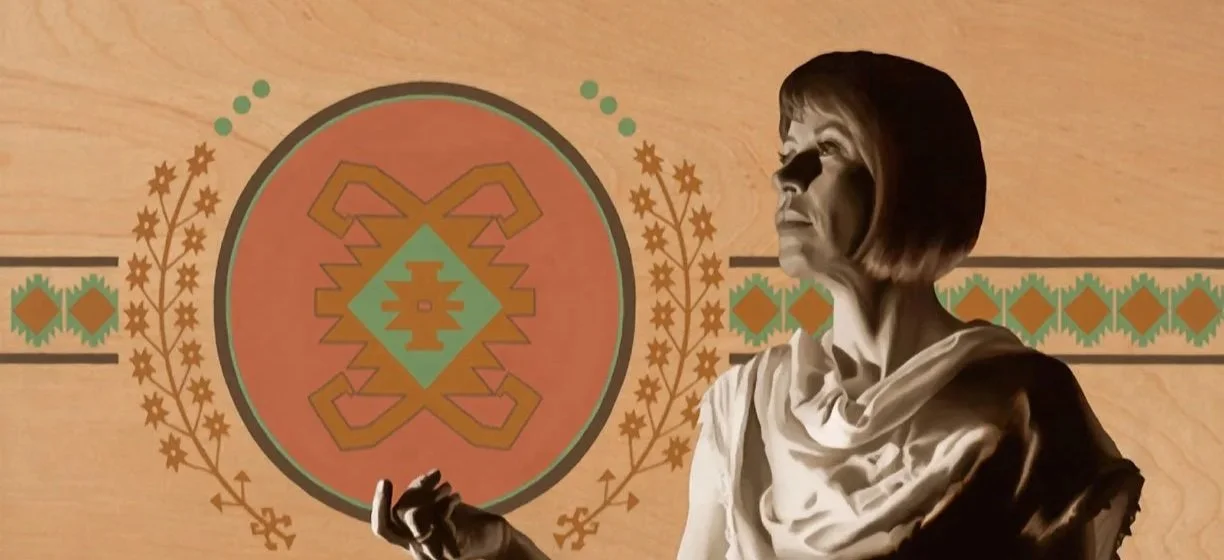
Sanija
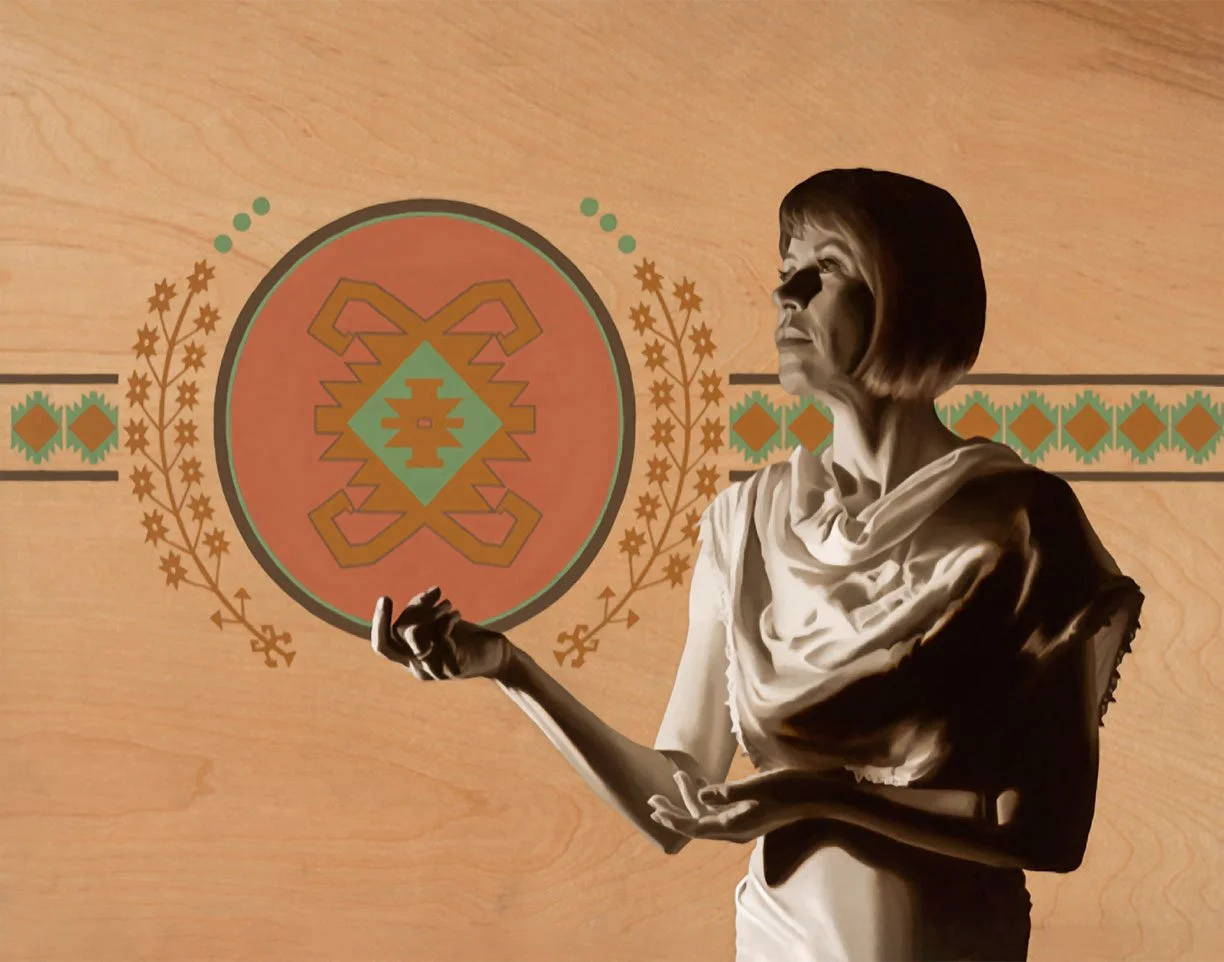
This painting narrates the story of Sanija. I met her while traveling to Berlin for my project Women Across Borders. Sanija escaped the Bosnian War/Genocide as a teenager and has long been resettled in Berlin. She is an art historian, a performance artist, and works full-time with fellow refugees.
It is extremely disheartening for Sanija that there is so little known about the Bosnian War/Genocide. Most information was intentionally swept under the rug for political reasons. She wanted to educate the public through this painting, which is why she is depicted looking to the past with hands drawn up as if to guide us to look with her. According to the Houston Genocide Museum “Starting in April 1992, Serbia set out to “ethnically cleanse” Bosnian territory by systematically removing all Bosnian Muslims, like Sanija, who are known as Bosniaks.
Many Bosniaks were driven into concentration camps, where women and girls were systematically gang-raped, and other civilians were tortured, starved and murdered.
In 1993, the United Nations declared that Sarajevo, Goradze, Srebrenica and other Muslim enclaves were to be safe areas, protected by a contingent of UN peacekeepers. However, in July 1995, Serbs committed the largest massacre in Europe since World War II in Srebrenica. An estimated 23,000 women, children, and elderly people were put on buses and driven to Muslim-controlled territory, while 8,000 “battle-age” men were detained and slaughtered with the intention to rid society of male Bozniaks in order to stop the bloodline and impregnate and assimilate the women. The so-called “safe area” of Srebrenica fell without a single shot fired by the UN. In 1994, NATO initiated air strikes against the Bosnian Serbs to stop the attacks. In December 1995, U.S.-led negotiations (The Dayton Peace Accords) ended the conflict in Bosnia, and a force was created to maintain the ceasefire. Sanija is seen in the painting wearing a traditional Bosnian scarf. These scarfs are used to pay respect to the women survivors, the expelled masses and the men that were massacred. She is also wearing an armband which was used by the Serbs to identify Muslims to round up and kill. Her armband is black instead of white to acknowledge the darkness of what happened.
“It took me 16 years to stabilize my life in Germany. The whole time in fear of being deported” she told me. Even after living in Berlin for almost 2 decades she had little access to services: “I was denied education in Germany and so I started studying in Austria, where I wasn't allowed to live. It was very hard to organize and keep it up, but I graduated with a Ph.D. in Art History with a focus on healing trauma through art. I had to fight for every little thing that I’ve accomplished here.”
In 2008 both she and her husband gained citizenship. They had been together for 10 years but were waiting for the stability of becoming legal citizens to have their first child together. Sanija explained, “As long as our situation was insecure, I didn't dare to become a mother.” In the painting, there are three green dots on either side of the circle to represent the three members of her family: her husband, son, and herself. Sanija feels that trauma transfers through generations, and before bringing a little one into the world, not only did she want to have a secure environment, but she was determined to address and heal her own trauma.
Aside from her outside circumstances at that time, she also had issues from her own upbringing to confront: “I lived most of my childhood in foster-families and I saw my father only once a year, in his village.” It was the only place that she felt connected to as home. That same village was destroyed and all its inhabitants were expelled or killed, there was not one house standing during the war. When she went back to visit, the only thing that remained were the pheasants that somehow still lived and roamed about. Sanija feels like she can identify with these creatures because of their resilience and strength to live on.
In Bosnia, traditional woven rugs are called Kilims. They each have specific designs expressing the hopes and wishes of different stages appropriate to their own circumstances. In the painting, there are two traditional Kilim designs of the “Tree of Life”. They also resemble feathers that represent the pheasants’ nature for survival. The two “tree of survival” symbols are cusping a circle that is encompassing the Kilim design “Turtle Carrying the World on its Back”. This symbol stands for durability and safety. Sanija has had to embody these qualities to move through her past and get to where she is today, and through all of it has made it her life passion and duty to help others do the same. In her day job, she helps guide and provides resources for refugees, and through her art, she tries to create political narratives that educate and empower her diverse community.
In the painting, there is also a diamond-shaped Kilim motif that runs horizontally across the background. This symbol is to ward off the evil eye. She explained to me that people had witnessed atrocities being committed on their Muslim neighbors during the war, but later denied that they had ever happened. This created more separation and animosity and perpetuated the violence (evil eye) in communities that had once lived together in harmony. Sanija feels that there are many tools to help heal these wounds. For her, communication through art is the most powerful, because compassion and empathy are easier to understand when felt. She believes that when violence occurs, we must process through it as soon as possible and talk about it because when you don't address the unjust past, it comes back up with greater violence. Sanija also makes a point to collaborate with other cultures that she is expected to dislike based on their faith or race to better understand their perspectives and to prove that peace and love are possible between all people.
Sanija was very excited co-collaborate on this project and stated, “Trauma feels sometimes as losing parts of your soul. And your paintings are, in my personal emotional experience, bringing soul-parts back.”
Details
“Sanija”
Jodie Herrera
Oil on wood
24'“ x 36”
Info
Created: 2019
SOLD